
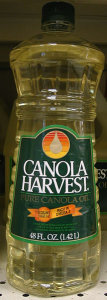
 Back in the 1960's, the food industry was in search of an oil that could be produced cheaply, but marketed toward health-conscious consumers. While olive oil was preferred amongst those who cared about their health, it was never easy or cheap to mass produce. As a result, the food industry began selling rapeseed oil as a supposedly healthy substitute. Serious problems were later discovered with the erucic acid in rapeseed, like the fact that it caused degenerative lesions in the heart muscles. It should not have been surprising to the producers, since rapeseed is so naturally poisonous that insects avoid it. Food companies decided to sell it anyway, even after realizing the serious liability risk.
Starting in 1964, the food industry joined forces with the chemical and nuclear industries to begin work in reducing rapeseed's poisonous erucic acid content, in the hope of producing a less toxic version of rapeseed oil. It had been banned in the U.S. in 1956. It would take the industry over a decade and enormous amounts of genetic engineering to get rapeseed oil back into the U.S. market. The resultant plant from the genetic modifications was originally called L.E.A.R. (low erucic acid rapeseed) and it is sometimes still called that within the food industry. It has been widely renamed to "canola" for marketing reasons, because no company wanted to market a cooking oil that had been officially banned for causing permanent heart damage, and having "rape" in the product name was considered a liability too.
The promoters of canola freely admit that its name was only changed for marketing purposes, which serves only to perpetuate the deception about its true lineage, as if canola were a totally different plant from rapeseed. This Frankenstein plant may be even worse than its parent rapeseed, for canola cooking oil is an E.P.A. registered pesticide. It is far from the natural product of selective breeding that its proponents contend. Canola oil was invented in a biotechnology laboratory in 1976, using radiation bombardment techniques to destroy parts of the plant's DNA. This produced the first canola plant that has ever existed in the world.
This comes from the official Canola Council of Canada:
"Here are some key facts on growing genetically modified (GM) canola in Canada.
"GM or transgenic canola varieties have been modified to be resistant to specific herbicides. They are called herbicide-resistant varieties. The plants are modified, but the oil is not modified. It is identical to canola oil from non-modified or conventional canola.
"Herbicide-resistant GM canola is grown on about 80% of the acres in western Canada. GM canola was first introduced in 1995."
The figures cited in the previous quotations are dated. About 90% of the canola was genetically engineered to be herbicide resistant at the time this was written. The quotation betrays that canola has been through two separate generations of genetic engineering: first to create the low erucic acid rapeseed that was renamed to canola, and then to further genetically modify it for herbicide resistance. No canola in the United States has any labeling to indicate that it is genetically engineered, or any labeling to indicate that it is a variety of rapeseed.
The following quotes come from the research paper, Genetic Control of Fatty Acid Biosynthesis in Rapeseed, which was published in The Journal Of The American Oil Chemists' Society when work on modifying rapeseed began. Here are a couple of snippets from that report, explaining exactly how canola oil (L.E.A.R.) began life:
"Self-pollinated seed harvested from each plant was oven-dried, weighed and crushed with a glass rod in a 50-ml Erlenmeyer flask containing 10 ml solution of methanol, acetyl chloride and benzene in the ratio of 20:1:4. The mixture was refluxed under an air condenser for 1 hr to extract and esterify the seed oil. A known wt of internal standard (dibutyl sebacate dissolved in carbon tetrachloride) was added and 0.2-0.4 ~1 of the sample injected into an F and M model 500 gas chromatograph operated at 208c with a helium flow rate of 75 ml / min and using an 8 ft 3/16 in... At the base of each pod, 10 ~1 aqueous solution of radioactive sodium acetate (0.2 ,c methyl labelled) was injected with a Hamilton micro-syringe. A branch from a rapeseed plant bearing 15 pods was excised below the lowest pod, the pods were similarly injected..."
What was noticeably absent from the procedure was any mention whatsoever of controlled pollination, which the canola marketers have been swearing was at the core of their 'organic' selective breeding process to create 'all-natural' canola. Part of the propaganda used to deceive us about canola oil's safety involves the fact that its manufacturer's laboratory tests have shown it to be a more-or-less healthy cooking oil, until it is actually heated. Then canola undergoes a chemical transformation. Canola is technically a healthy cooking oil -- provided that it is never actually cooked. As long as it remains cold and inside its air-tight bottle or test tube -- it tests to be healthy. However, once heated, canola oil produces high levels of 1,3-butadiene, benzene, acrolein, formaldehyde, and other related compounds which become infused into the foods being cooked. All traces of omega-3 are gone.
Canola shares soy's hormone-disrupting tendencies. Canola oil is also noted to produce cancer-causing toxic fumes when heated, and at much lower temperatures than are required to cause equivalent smoking by other cooking oils. Rapeseed and canola oil fumes are the primary reason for the surprisingly high incidence of Asian lung cancers, despite tobacco smoking being a rarity. Canola fumes have been known to kill pet birds, and many readers will remember that canaries were once used in coal mines to detect the presence of poisonous gases.
Dr. Joseph Mercola was the first person who was brave enough to go against the collective grain by attacking the fraudulent canola industry, and he was right to do it. As reported by Dr. Mercola:
"Canola oil was developed from the rape seed, a member of the mustard family. Rape seed is unsuited to human consumption because it contains a very-long-chain fatty acid called erucic acid, which under some circumstances is associated with fibrotic heart lesions. It has a high sulfur content and goes rancid easily. Baked goods made with canola oil develop mold very quickly. During the deodorizing process, the omega-3 fatty acids of processed canola oil are transformed into the dangerous trans fatty acids, similar to those in margarine, and possibly more dangerous. A recent study indicates that 'heart healthy' canola oil actually creates a deficiency of vitamin E, a vitamin required for a healthy cardiovascular system. Other studies indicate that even low-erucic-acid canola oil causes heart lesions, particularly when the diet is low in saturated fat."
Our recommendations include using extra virgin olive oil that is cold pressed for most recipes and using peanut oil for high heat recipes, such as frying. Sunflower oil (not to be confused with safflower) is an acceptable alternative to olive oil. For high-heat cooking and frying, peanut oil is absolutely the safest choice. It is the rapid break down of other oils that make fried foods unhealthy. Butter is good for use with practically every recipe, and natural (preferably organic) butter should be a core component of every diet. Always be watchful of the "smoke point" temperature of an oil, because smoking is an indication of dangerous break-down.
Sources
Approval of Pesticide Product Registrations, Environmental Protection Agency
http://www.canolacouncil.org/, Canola Council
Genetic Control of Fatty Acid Biosynthesis in Rapeseed, National Research Council of Canada
Mutagens from heated Chinese and U.S. cooking oils, National Institutes of Health
Identification of 13-butadiene benzene and other volatile organics from wok oil emissions, National Institutes of Health
Industrial Base Oils, Cargill
Related Articles
Why Rancid 'Healthy' Oils Are More Dangerous Than The Bad Oils
The Legend of Mike Adams and the Reality